
Fenallely has always been driven by curiosity. Growing up, she imagined herself pursuing higher education, even when she was unsure of which direction to take. “I’ve always been someone who’s very interested in learning,” she shares. As a first-generation student, her path was one she had to carve out largely on her own. “From my family, I was the first one to graduate college.” After high school, she enrolled at Southern New Hampshire University (SNHU), eager to continue her education. Like many other students, Fena was met with increased family responsibilities during the COVID-pandemic, which led her to take a break.
When she was ready to return to college, Fenallely searched for a path that would allow her to keep learning while balancing real-life responsibilities. She enrolled into SNHU through Duet, which offers low-cost, flexible, project-based degree programs designed for working adults. She then discovered the Alray Scholars Program. Duet’s flexible degree model offered her flexibility and structure, while Alray offered a community of support she didn’t have before.
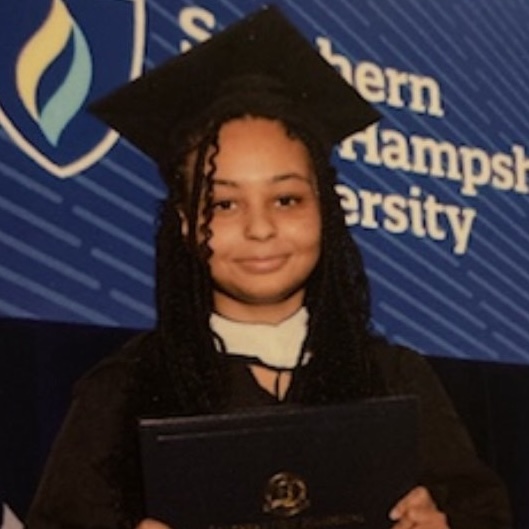
“My mentor was close to my age, which was very different for me. I felt like we could resonate a lot with each other. At moments when I had anxiety about different personal things, they provided support to keep me centered through the journey.”
“What motivated me was wanting to grow and learn. I wanted to continue my education and make an impact,” she says. Working in healthcare while returning to school helped give her a renewed sense of purpose. “It feels good to make a difference in people’s lives.” While still in school, Fenallely earned a promotion at her healthcare job which she considers one of her proudest accomplishments. “That was big for me,” she says. “It happened while I was still in school, and it felt really rewarding.”
Fenallely majored in healthcare management, drawn to a field that allowed her to help others while better understanding the systems that shape patient care. “I grew up in a Hispanic family, and sometimes there’s misinformation about the healthcare field. When there’s misinformation, it makes me want to know more,” she explains. “I wanted to learn more about what the healthcare system really entailed, and make a difference.”
In addition to financial support, Alray gave Fenallely a community she could rely on. The mentorship she received proved especially meaningful. “My mentor was close to my age, which was very different for me,” she explains. “I felt like we could resonate a lot with each other. At moments when I had anxiety about different personal things, they provided support to keep me centered through the journey,” she says. Her mentor provided guidance on everything from navigating the workplace to understanding health insurance. “Hearing the same advice can have different weight depending on who says it, and I appreciated having someone that I resonated with,” she says.
Alray’s career services workshops and graduate panels allowed her to see a future she once struggled to picture. “I think being able to hear from people in different career fields was really helpful. It opened my eyes to different career options. The grad school panel was also really helpful,” Fenallely shares. She vividly remembers connecting with Ross, a Career Advisory Board member in biotech. “We talked about lifestyle and career pathways, because many people major in one thing but end up doing something different. Sometimes seeing the future can be hard. Seeing other people who are in different positions or have moved into different fields was very motivating for me.”
Reflecting on her experience with Alray, the sense of community and being able to build connections were the most meaningful. “I did school online, so I felt very disconnected,” she admits. “I truly appreciated the opportunities to connect with others. The sense of community meant a lot to me.” Now having completed her bachelor’s degree, she is looking to pursue a master’s in health informatics. Her current role in an advanced care at home program sparked a growing interest in the intersection of healthcare and technology. “Patients receive care in their homes—it’s very innovative,” she says. “I want to learn more about the tech and data side. I think it meshes well with the hospital-at-home model.”
Fenallely’s story was captured and written by Julianne Stein.